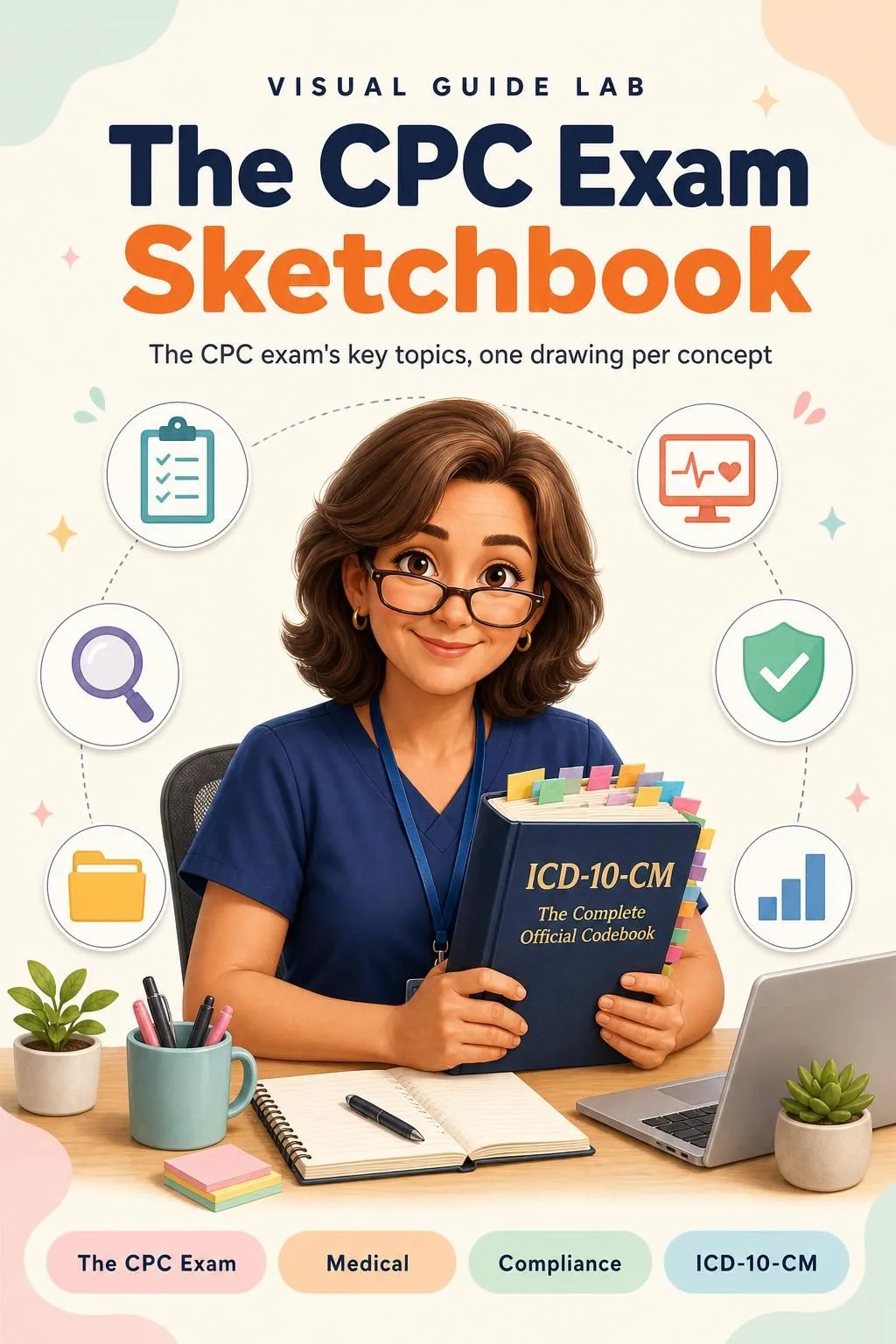
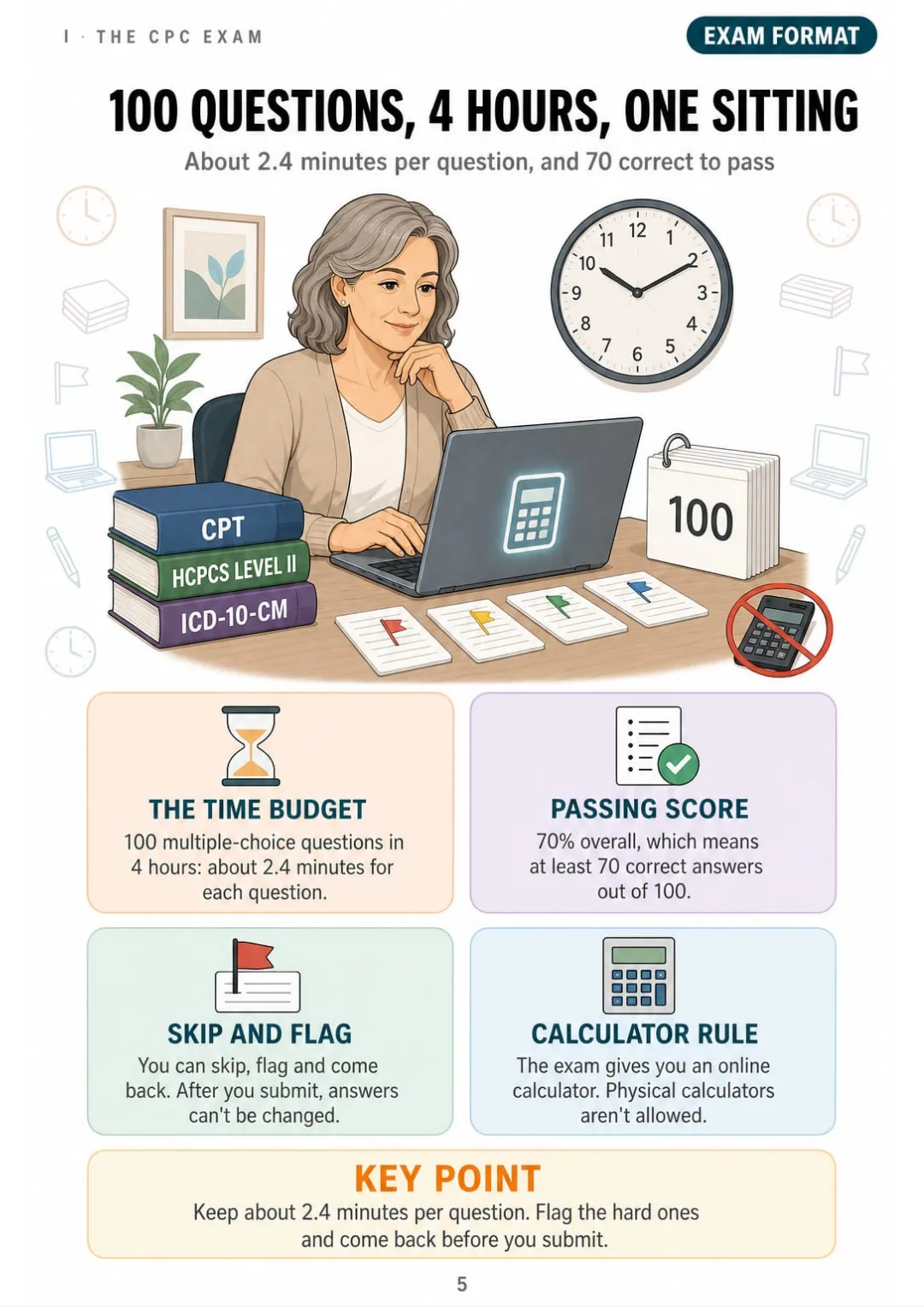
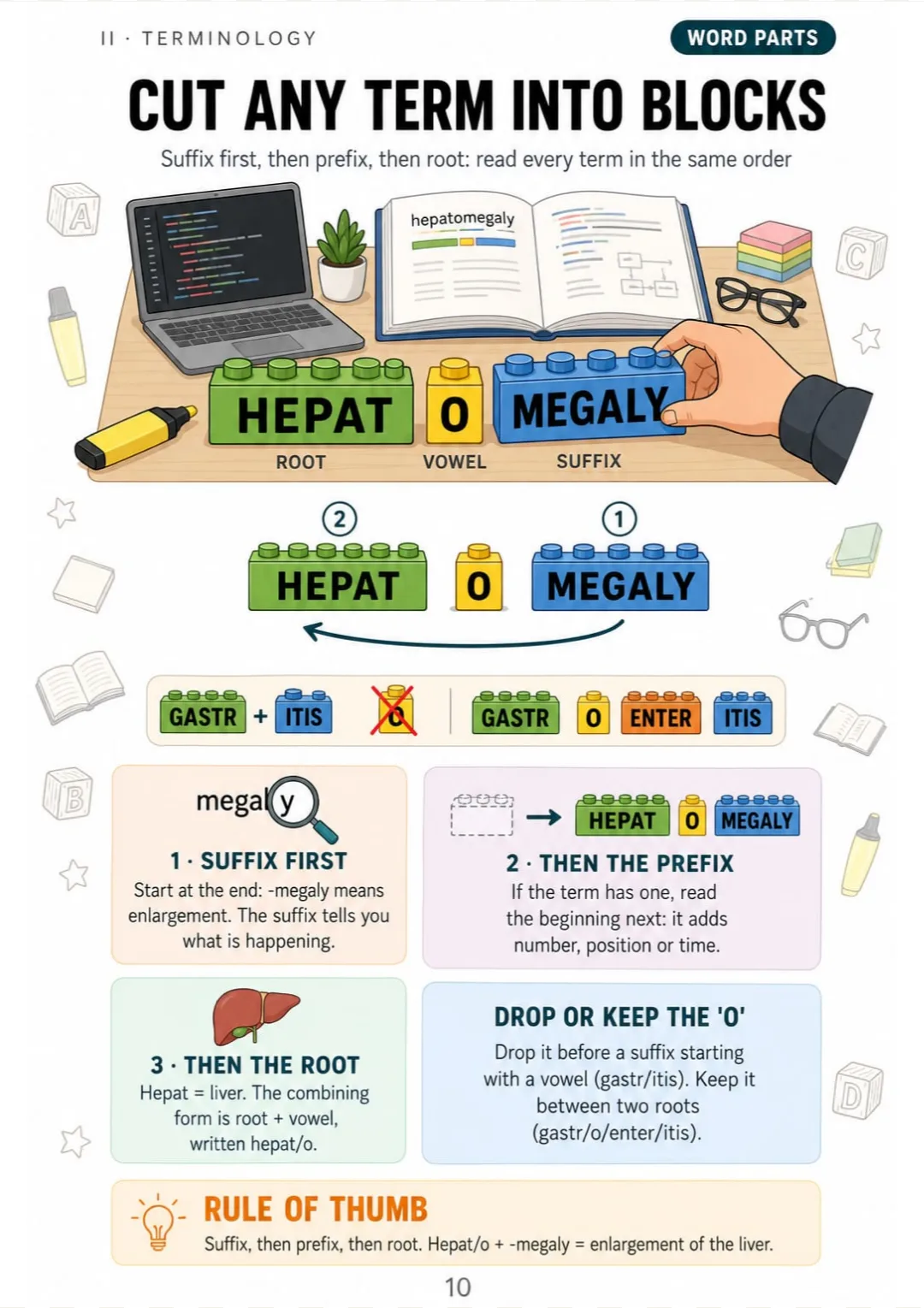
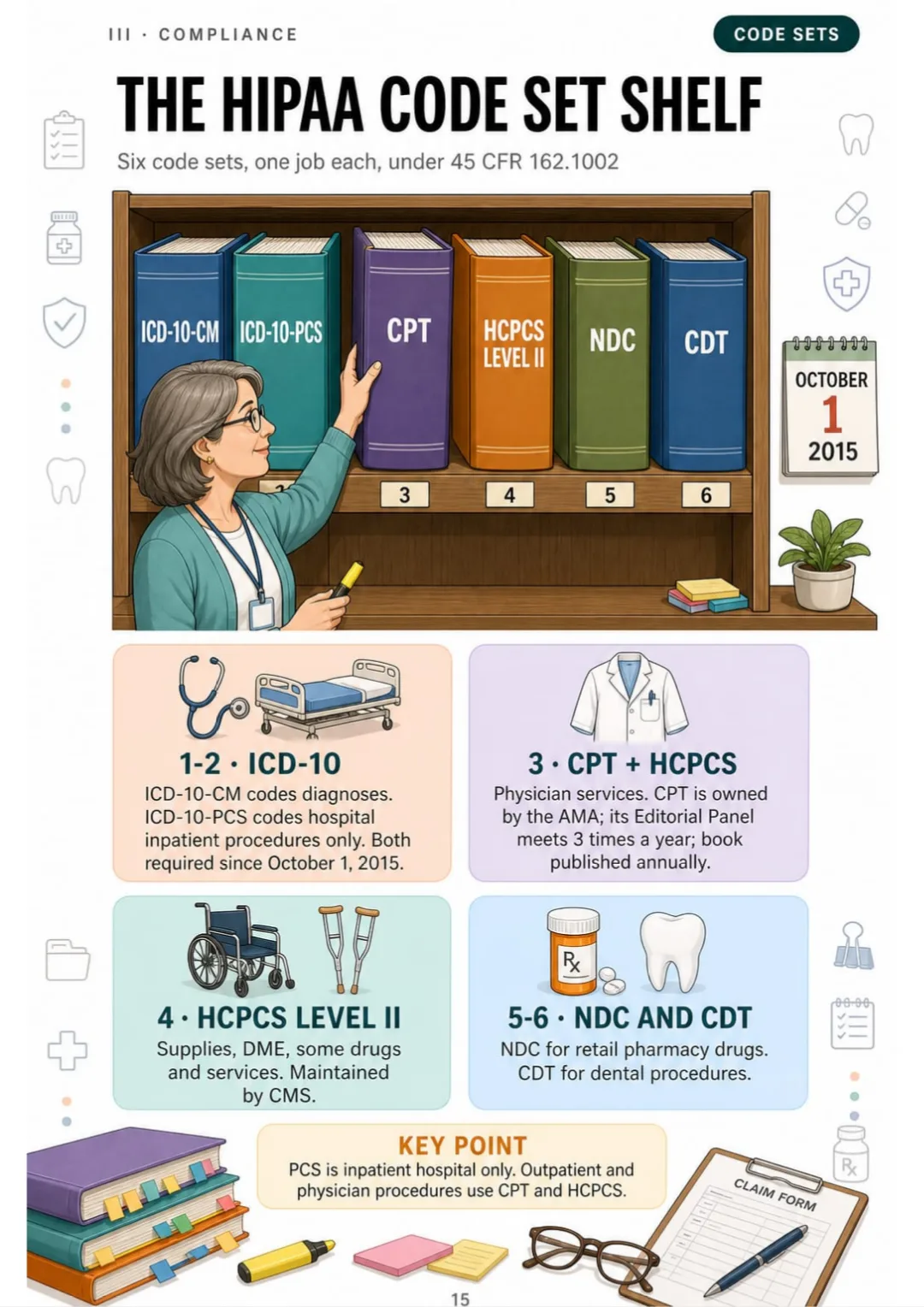
The CPT map, modifiers 25 and 59, Excludes1 and Excludes2, wound repairs, E/M by MDM, anesthesia units and NCCI edits: in your notes it's a wall of text. Here each topic fits on one page, with the drawing and what you need to remember. 65 illustrated pages.
🔒 Secure checkout · PDF by email · 30-day guarantee
One topic per page, the drawing that shows you how the rule works, and the boxes with what you need to know:


Swipe to see more →
These are real pages from the book. The table of contents is the full one: 11 parts and 61 topics.
You've read the CPT Surgery guidelines three times. You close your notes...
...and when a practice case says "lung biopsy," you still don't know which range to open. It was just lines in a row.

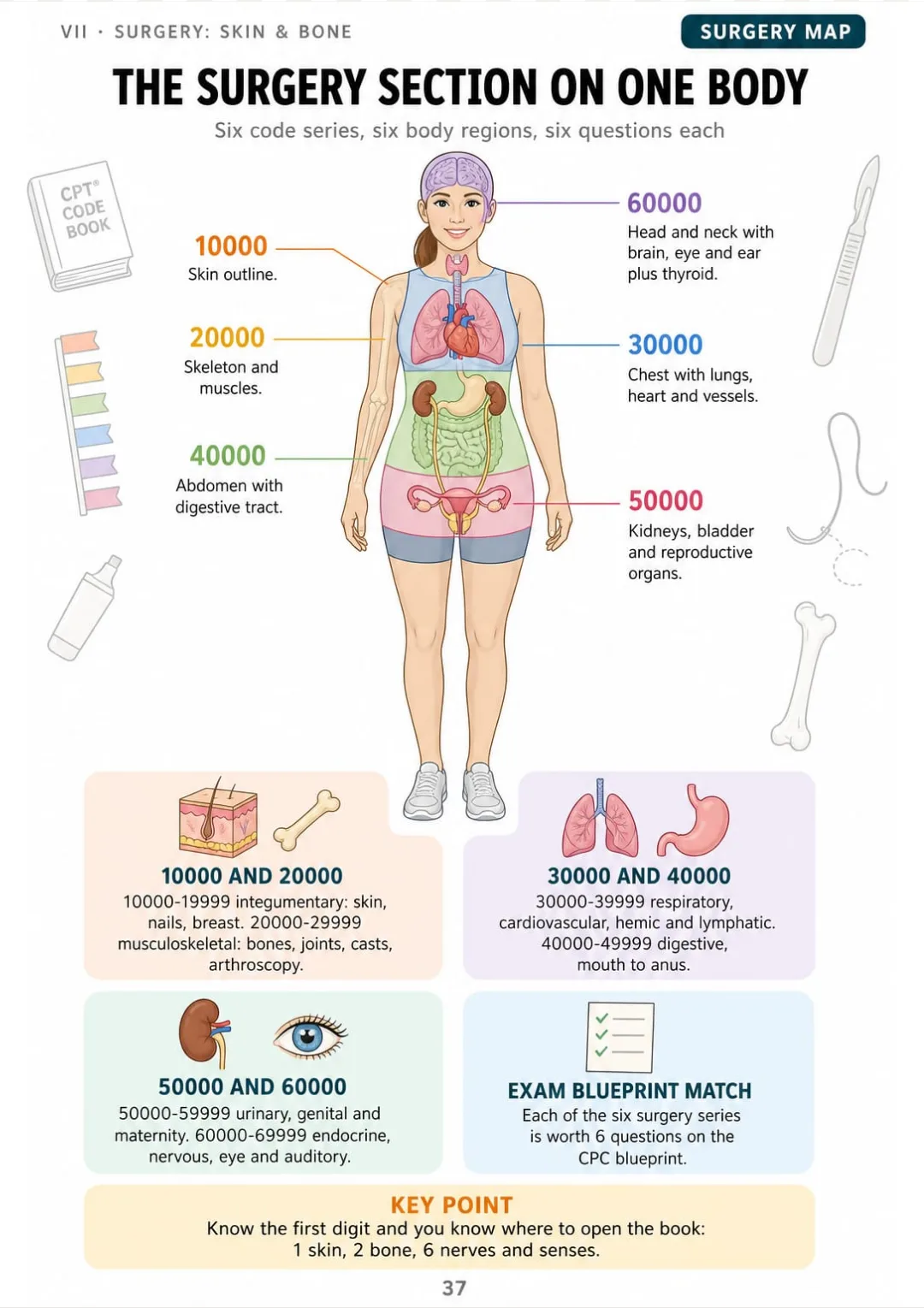
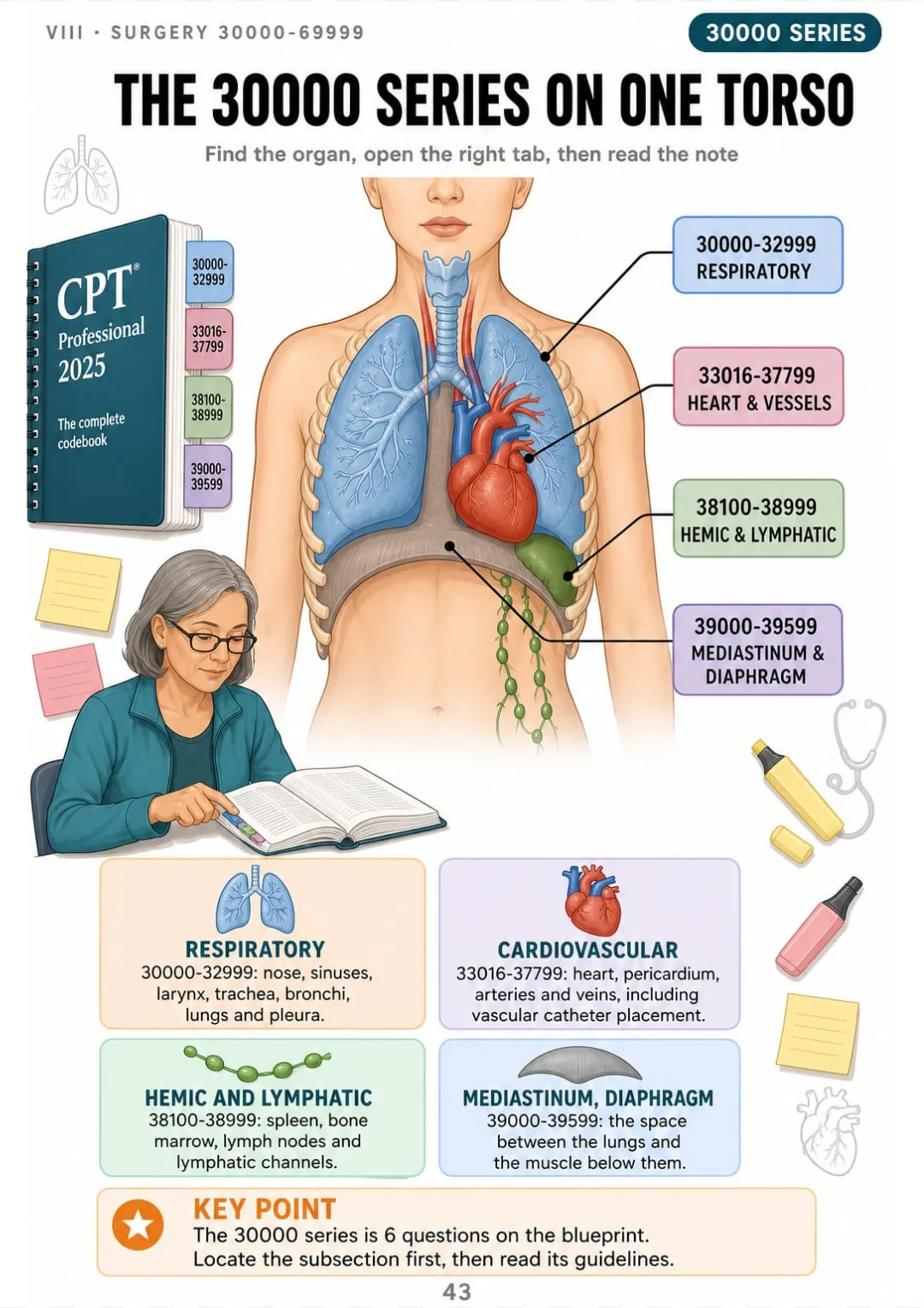
Here the Surgery section is one drawn body: the 10000s are skin, the 20000s bone, the 30000s the chest, each range right where it sits.
And the same goes for modifiers 25 and 59, adding repair lengths, the MDM table and anesthesia units: each one gets its own page.
First you understand why it works that way. Then the order sticks on its own.

The exam, terminology and anatomy, compliance and code sets, ICD-10-CM, diagnosis guidelines and HCPCS, CPT and modifiers, surgery from skin to ear, E/M, anesthesia and radiology, and pathology, lab and medicine: 65 pages, all drawn
Picture this:
Instead of rereading half a page about modifier 59 without being able to picture it...
...you open the page and find a decision tree: same patient, same day, then the one question that sends you to 59 or to XE, XS, XP or XU.

And Excludes1, wound repairs, the MDM table, anesthesia units and NCCI edits turn into drawings and tables you can read at a glance.
You stop repeating and start understanding.
That's what The CPC Exam Sketchbook does: 11 parts in exam order, one drawn topic per page, and at the end ten case questions solved step by step. Because what you see in order is easier to find again.
Because what your brain sees organized, it remembers.
How the 100-question, 4-hour exam works, so nothing on test day surprises you: the blueprint by content area, vouchers and test sites, the books, notes and tabs you may use, and results and the CPC-A.
Word roots and combining forms, prefixes for number, position and time, surgical suffixes, directional terms and body planes.
The HIPAA code sets and who maintains them, covered entities and minimum necessary, the 60-day breach clock, NCCI edit pairs and MUEs.
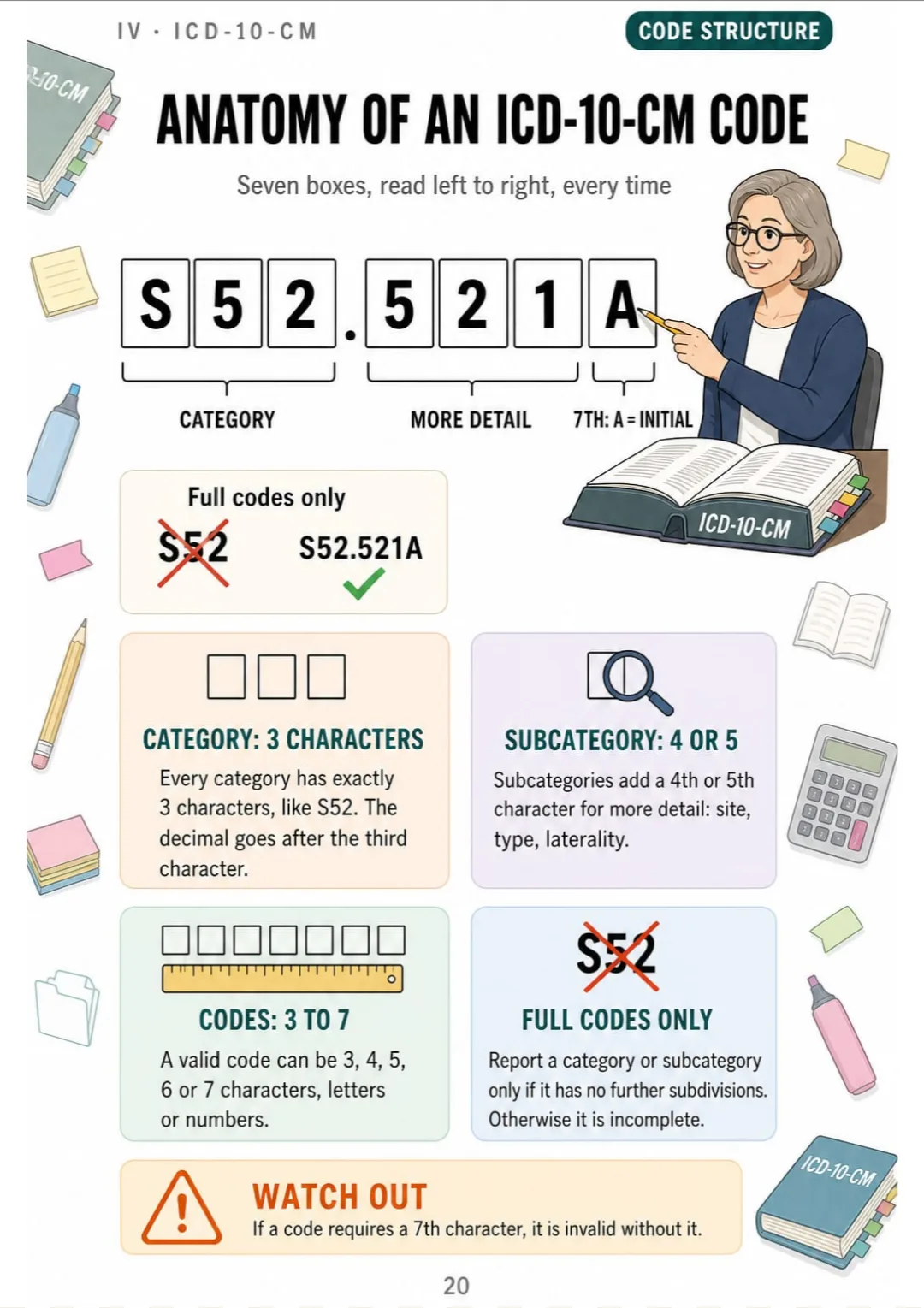
The 3- to 7-character code, from the Alphabetic Index to the Tabular List, NEC and NOS, Excludes1 vs Excludes2, code first and use additional, 7th characters and the placeholder X.
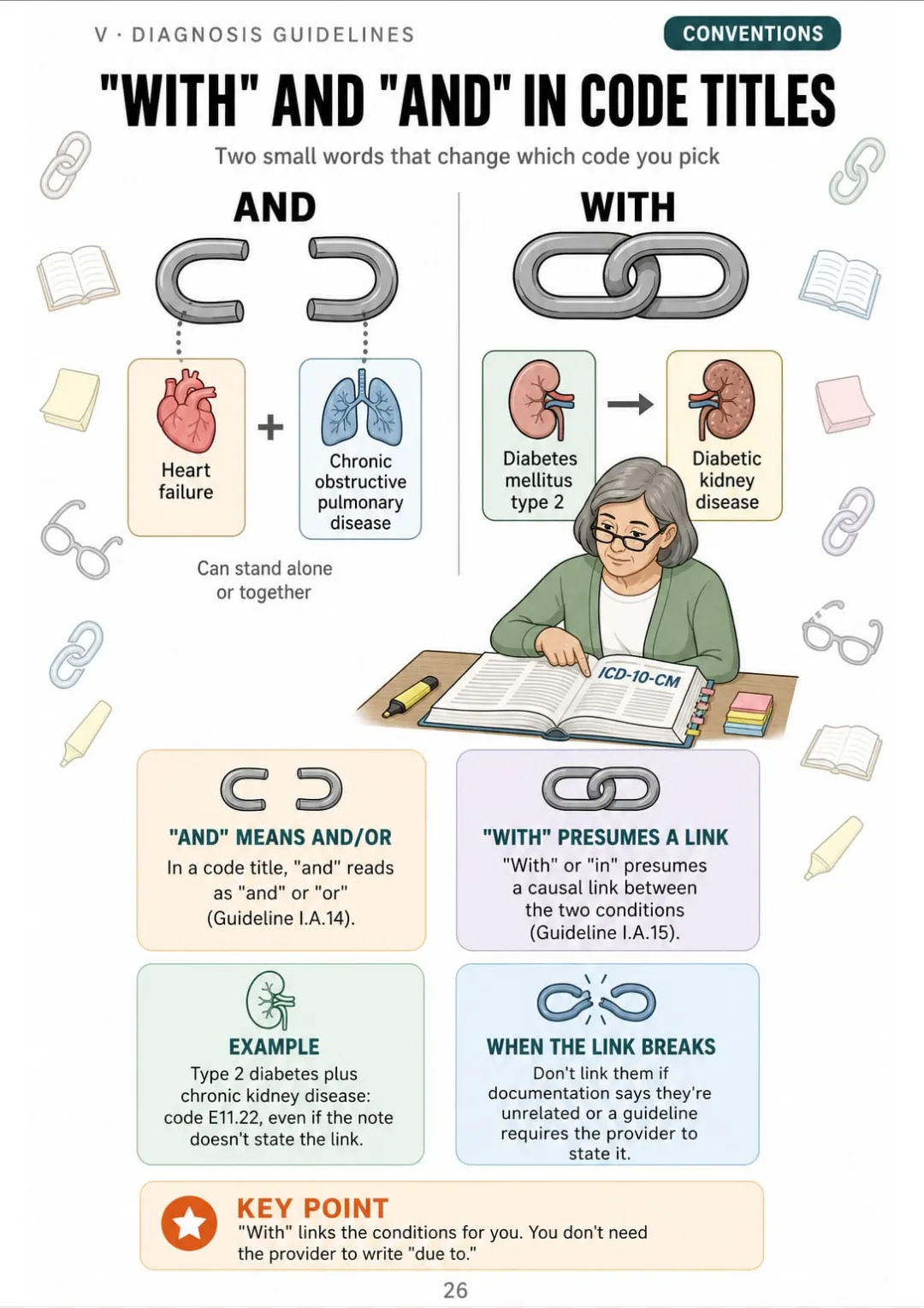
“With” and “and” in code titles, laterality, signs, symptoms and sequela, the outpatient rule for uncertain diagnoses, and HCPCS Level II.
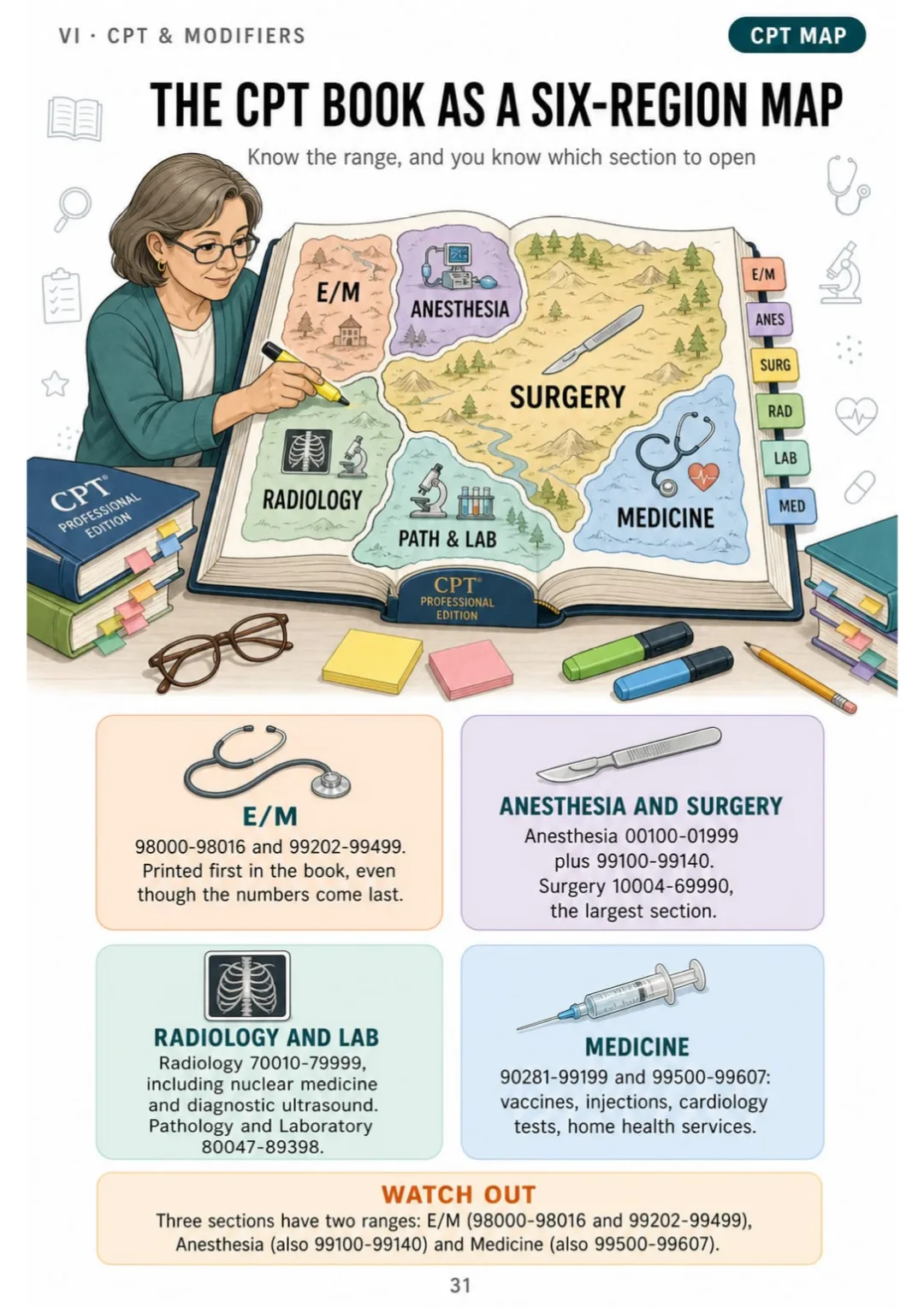
So you know where a code lives before you search: the six CPT sections and their ranges, Category II and III, add-on and unlisted codes, global periods, and modifiers 25, 59, XE/XS/XP/XU, 51, 50 and LT/RT.
The Surgery section by body system, simple, intermediate and complex repairs, adding repair lengths, lesion excision, fracture care and arthroscopy.
Respiratory, heart and vessels, selective catheter placement, endoscopy, urinary and genital bundles, the obstetric package, and nervous system, eye and ear.
New vs established, MDM or total time, the MDM table, office visit time thresholds, prolonged visits with G2212, critical care, split/shared visits and 99211.
The anesthesia formula and 15-minute units, physical status P1–P6, modifiers AA, QK, QX and QZ, modifiers 26 and TC, and contrast and fluoroscopy.
Lab panels and modifier 91, surgical pathology and cytopathology, injections and infusions, vaccine plus administration, and ten case questions with a step-by-step method.
At the end of the book: Ten case questions solved with a step-by-step method.
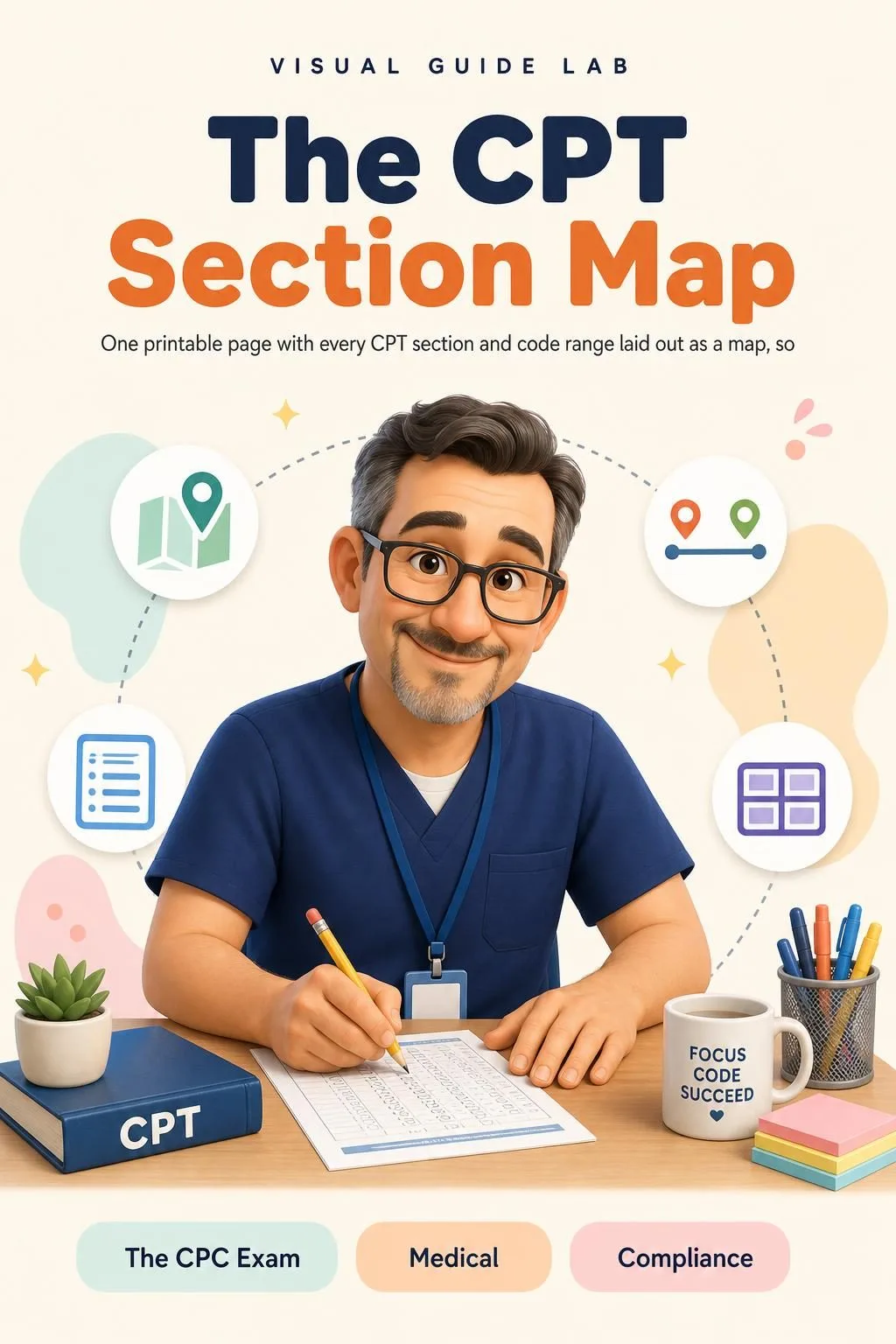
One printable page with every CPT section and code range laid out as a map, so you know which part of the manual to open before you start searching.

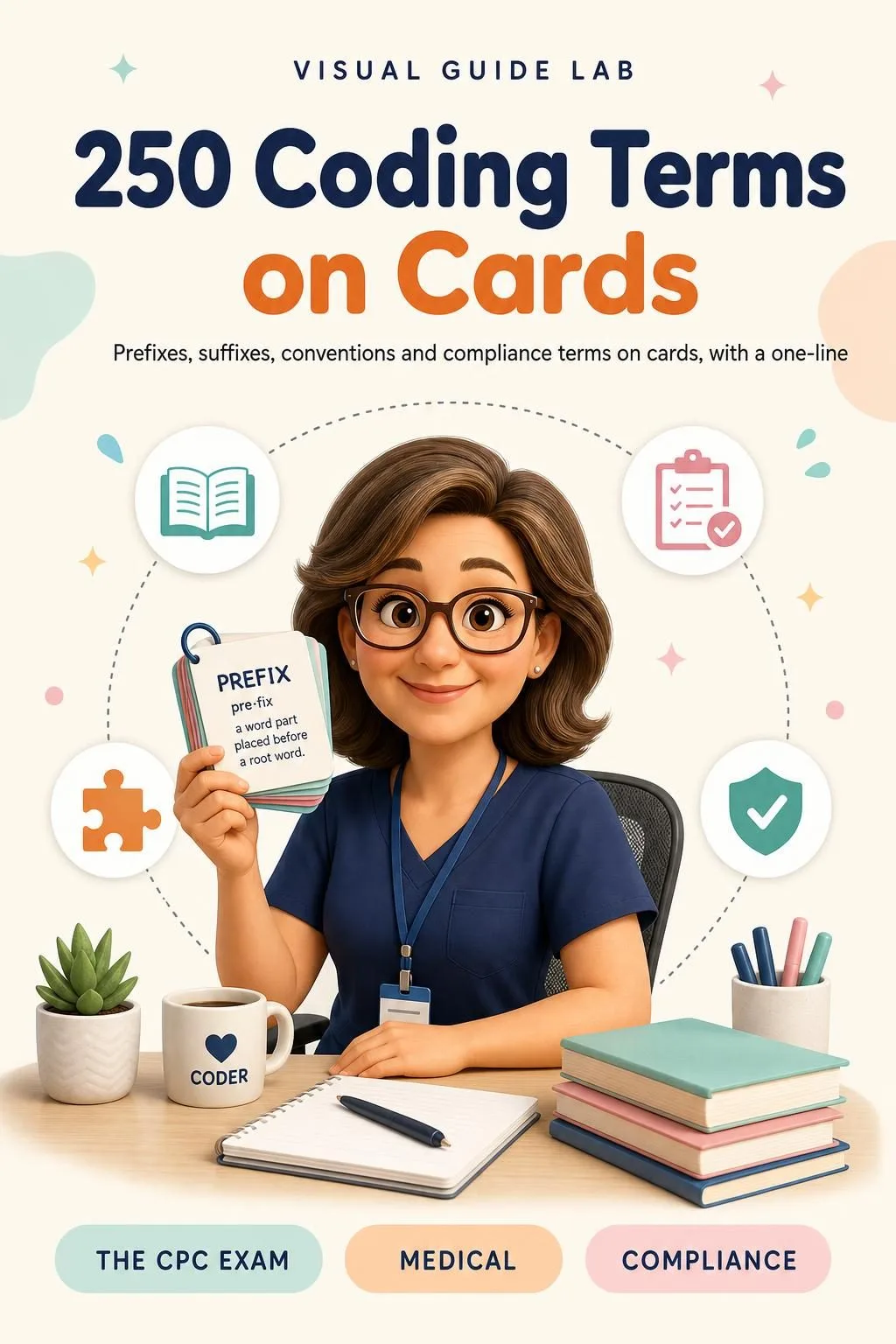
Prefixes, suffixes, conventions and compliance terms on cards, with a one-line definition and a tiny sketch on the back, so you can test yourself in spare minutes.
📄 This is a digital PDF book sent to your email: nothing is printed or shipped.
PDF by email: The CPC Exam Sketchbook reaches your inbox as a PDF, and the two free books come by email too. One-time payment, no installments or hidden costs.
Terminology, ICD-10-CM, CPT and modifiers, one topic per page, to review at night right next to your code books.
Every content area in exam order, so you can go straight to the areas your score report flagged, plus ten case questions solved step by step at the end.
Front desk, billing or nursing: a quick visual review of what you already see every day, from modifiers 25 and 59 to E/M levels by MDM.
📄 This is a digital PDF book sent to your email: nothing is printed or shipped.
30-day guarantee: tell us what didn't work and we'll refund 100%.
You have 30 days to try The CPC Exam Sketchbook and the two bonus books. If it doesn't work for you, tell us what didn't work and we'll refund 100% of what you paid. One-time payment, no subscriptions, no surprises.
After your purchase you get an email with The CPC Exam Sketchbook as a high-resolution PDF, to read on your phone or print. The two bonus books, The CPT Section Map and 250 Coding Terms on Cards, also come by email.
A one-time payment of US$ 37. No installments and no subscription.
For adults preparing for the AAPC CPC exam, first attempt or retake. If you're retaking it, the 11 parts follow the exam's content areas, so you can go straight to the ones your score report flagged. If you already work at the front desk, in billing or in nursing, terminology is a quick review and the weight is on ICD-10-CM guidelines, CPT, modifiers and E/M. Check the table of contents above to see every topic.
AAPC's CPC exam guidance and approved code book list, the ICD-10-CM Official Guidelines for Coding and Reporting FY 2026 (CDC/NCHS), the CMS NCCI Policy Manual 2026, CMS HCPCS and E/M guidance, the Medicare Claims Processing Manual, Chapter 12, and HIPAA rules at 45 CFR Parts 160–164.
No. It's our own study guide and it isn't affiliated with or endorsed by AAPC, the AMA, CMS or CDC. No code descriptors are copied: you use it next to your own current-year CPT, ICD-10-CM and HCPCS books. It's built on the FY 2026 ICD-10-CM Guidelines and NCCI 2026. The pages teach you where to look and how each rule works; always confirm the final code in the books for the year you take the exam. You don't need to buy anything else to use it.
No. It's study material. It doesn't replace a course, your current-year code books or professional judgment, and it doesn't come with a certificate or CEUs. Only AAPC awards the CPC credential, after you pass its exam. What it does: it helps you see each rule and know where to look in your own books.
No. The ten case questions are written for this book and aren't official questions from any exam. They're there to help you practice the method.
Yes. The PDF is high resolution, so you can print the whole book or just the pages you need to have on hand.
30-day guarantee: tell us what didn't work and we'll refund 100%.
You don't have to reread the same page hoping it sticks this time.
You don't have to memorize rules you can't picture.
And you definitely don't have to walk into the exam without knowing where to start.
There's a simpler way. And it's one click away. Now it's your turn.
One-time payment: US$ 37 · Guarantee: 30 days · PDF by email
YES, I WANT THE CPC EXAM SKETCHBOOK FOR US$ 37📄 This is a digital PDF book sent to your email: nothing is printed or shipped.